
LEA Portal
An internal banking tool designed around legal operations, task management and day-to-day workflow clarity.
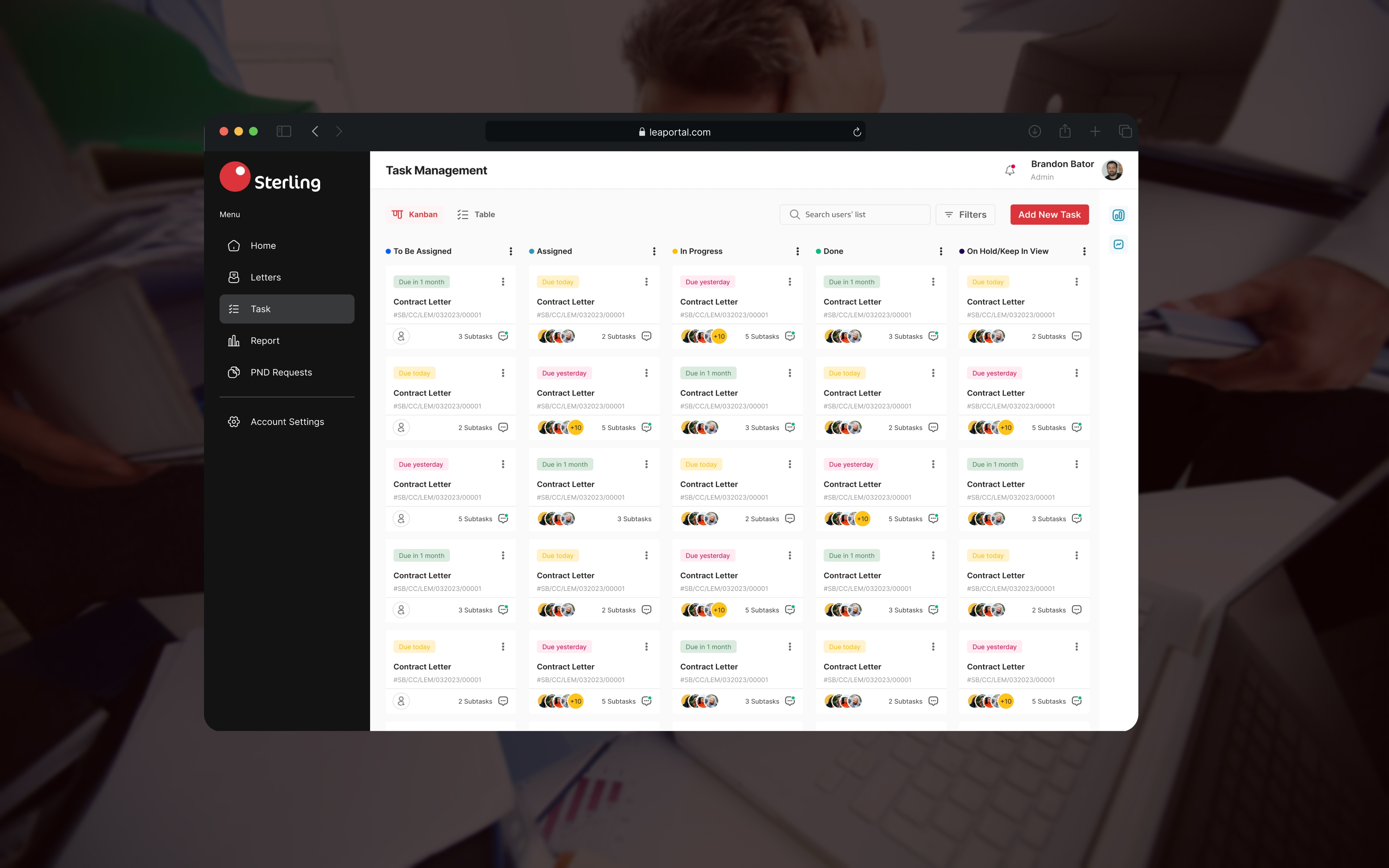
LEA Portal is an internal regulatory and law-enforcement agency management platform developed for Sterling Bank under Revent Technologies. As the Lead Product Designer, I worked on a web-based system for organising agency correspondence, case assignments, deadlines, escalations and administrative control.
The product connects internal staff submitting letters with the legal and LEA teams responsible for responding. It gives officers a clearer view of assigned work, gives administrators visibility across cases and regions, and keeps the original request connected to the tasks and follow-up that come after it.
The design work covered intake, tracking IDs, role-based access, task states, escalation paths, SLA handling, regional reporting and system administration. The goal was to make responsibility visible from the first letter through to resolution, especially in a workflow where missed deadlines can carry real operational consequences.
The portal is currently live and used internally at Sterling Bank. Because it is an internal banking tool, it is not publicly accessible.
The portal became part of Sterling Bank's internal workflow and helped demonstrate enough value for the bank to return for additional internal-tool work.
When requests live in manual processes, accountability gets harder.
The bank's manual handling of regulatory and law-enforcement correspondence created risks of errors, delays and incomplete tracking. Missed deadlines could lead to sanctions, so the brief was not simply to digitise a task list.
The central requirement was to track letters submitted to the legal department, assign them to the right people and escalate work before it slipped through the cracks.
Track every letter, make ownership clear and escalate requests before deadlines are missed.
Four roles, different responsibilities.
System administrator
Configures entities and subsidiaries, access rights, regions, branches, business units, agency categories and service-level agreements.
LEA administrator
Assigns tasks, oversees regional activity, monitors deadlines and reviews performance.
LEA officer
Works on assigned cases, updates progress and completes the necessary actions.
Internal staff
Submits agency letters and supplies additional information when requested.
Give every incoming letter an identity.
I structured each incoming letter around a generated tracking ID so the requesting agency, original submission, assigned case and follow-up tasks stayed connected.
This structure makes requests searchable and traceable instead of depending on disconnected correspondence or someone's memory.
Show where a request stands and who needs to act.
Task creation and assignment are built into the workflow. The documented states are To be Assigned, Assigned, In Progress, Overdue, On Hold and Done.
The system also supports collaboration and requests for more information, so a case can continue when the first submission is incomplete rather than disappearing into an informal follow-up.
Design for the cases that cannot follow a straight line.
The scope includes post-no-debit requests integrated with the bank's core banking solution, approval and notification flows, and staff invitations to agency offices that can create legal-preparation subtasks.
Service-level agreements and escalations help administrators respond to breaches, adjust assignments and notify the relevant people. These exception paths matter because compliance work rarely consists of one person completing one isolated task.
Give LEA Admins a bird’s-eye view without losing the cases underneath.
I designed the dashboard around the information an LEA Admin needs to manage a region: total letters submitted, tasks in progress and overdue work, alongside performance signals such as tasks completed within SLA, SLA breaches and average completion time.
These metrics are not decorative reporting. They help the administrator see where work is building up and then move into the underlying tasks that need attention.
Make the system configurable without losing oversight.
Administrators can manage organisational entities, user permissions, regions, branches, business units, regulators and agency categories. SLA configuration establishes the rules for task assignments and deadlines.
Dashboards and reports bring task status, activity and performance into one view for LEA administrators. Access is controlled rather than open: super administrators use approved credentials, while internal users are imported from Sterling Bank’s Active Directory so outsiders cannot create public accounts.
The internal tool became part of Sterling Bank's working process.
The portal is currently being used inside Sterling Bank to support the LEA workflow. The value of the design was practical: make ownership, deadlines and case progress easier to follow in day-to-day work.
The bank returned to build additional internal tools after this work, extending the relationship beyond the original portal. That follow-on work is a stronger signal of product confidence than inventing an efficiency percentage the project never measured.
Internal tools earn trust by making responsibility visible.
This project reinforced how much enterprise UX depends on exceptions, permissions and operational states, not only happy paths. The interface had to help people understand what was waiting, what was overdue, who owned the next action and what information was still missing.
The design story is about making responsibility visible across a sensitive, multi-role workflow from the first letter to its final resolution.
What the design changed.
The strongest impact is practical adoption: the portal became part of Sterling Bank's internal workflow and led to more internal-tool work.
Used inside Sterling Bank
The portal supports the bank's LEA and legal operations in day-to-day work. It is an internal tool, so it is not publicly accessible.
Ownership became visible
Letters, cases, assignees, deadlines and progress can be followed through one system.
Escalations are built into the workflow
SLA rules and task states make overdue or blocked work easier to identify and act on.
Different roles see what they need
Internal staff, LEA officers, LEA administrators and system administrators work from role-appropriate access.
The relationship continued
Sterling Bank returned to build additional internal tools after the portal project.